Project Overview
This project investigated the aeroelastic behaviour of a highly flexible polymer wing under varying angles of attack in a controlled, low-speed wind tunnel environment. The primary objective was to examine the relationship between aerodynamic loading, wingtip deflection, flow separation, and the onset of aeroelastic oscillations.
Working within a team of five, I was responsible for operating the wind tunnel and maintaining the required experimental airflow conditions. Testing was conducted at a constant airspeed of 20 m/s while varying the wing's angle of attack between −14° and +14°.
Following the experimental investigation, I independently processed and analysed the collected data using Microsoft Excel, producing graphical representations of lift coefficient, drag coefficient, and wingtip deflection. The findings were subsequently presented in an individual technical laboratory report.
Engineering Problem
Highly flexible aircraft wings are susceptible to significant structural deformation under aerodynamic loading. The interaction between aerodynamic forces, structural stiffness, and inertia can produce oscillatory behaviour and potentially lead to aeroelastic instability.
The engineering challenge was to investigate how varying angles of attack influence aerodynamic performance and structural deformation, while identifying the conditions associated with flow separation, stall, and the onset of wing oscillations.
Understanding these interactions is particularly important in the design of lightweight aircraft and unmanned aerial vehicles (UAVs), where structural flexibility can influence aerodynamic efficiency, stability, and operational safety.
Experimental Methodology
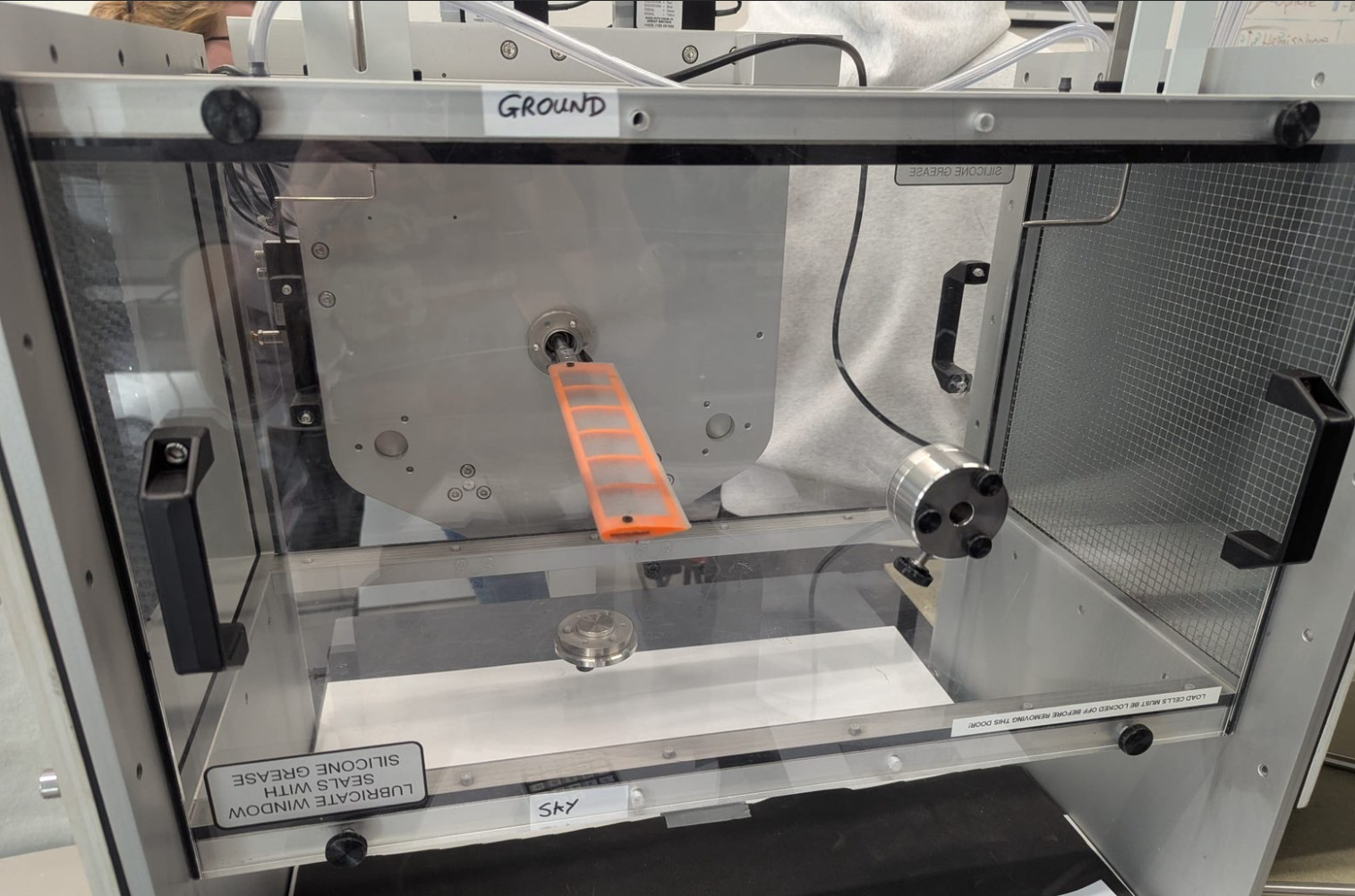
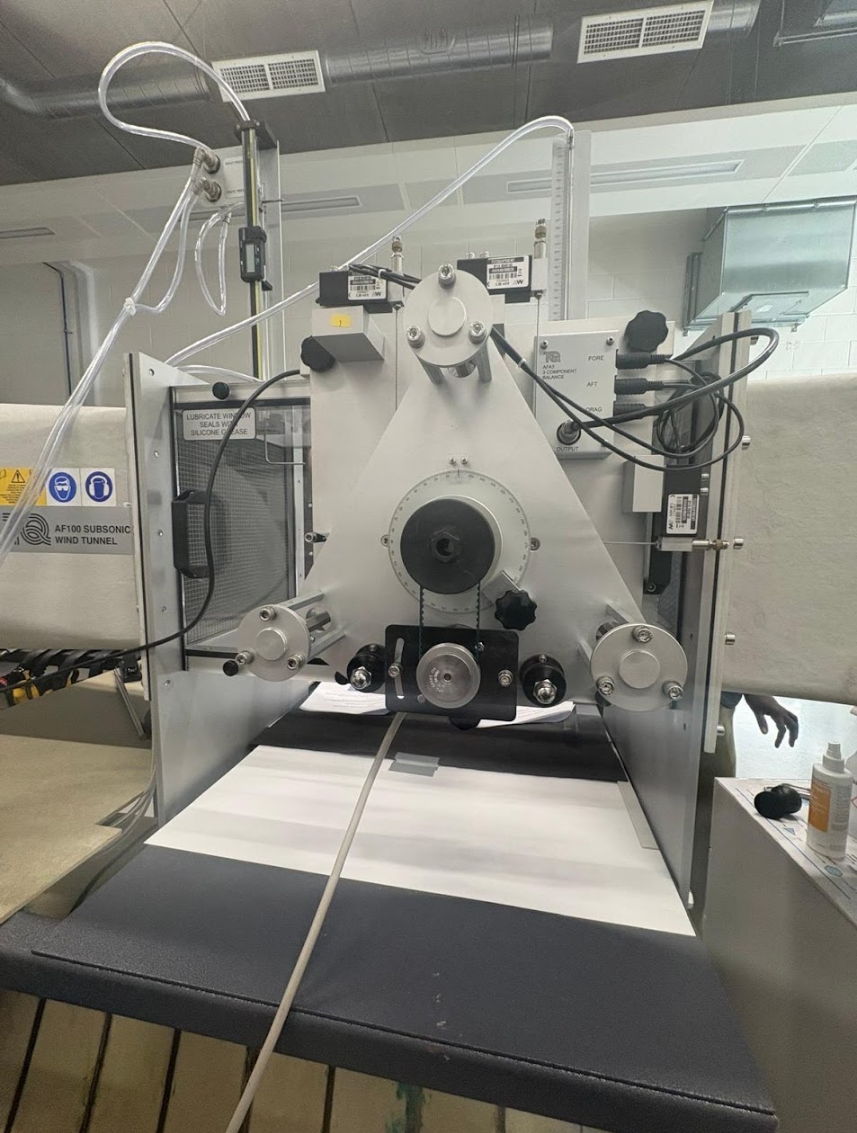
The experiment utilised a low-speed wind tunnel containing a highly flexible, 3D-printed polymer wing supported by a metal alloy spar. The wing was mounted to a three-component force balance, allowing aerodynamic loading to be measured while permitting bending and torsional deformation.
My primary responsibility was operating the wind tunnel to establish and maintain a constant airflow velocity of 20 m/s throughout testing. Maintaining constant airspeed enabled the effects of varying angle of attack to be investigated without introducing changes in dynamic pressure associated with airspeed variation.
The wing was tested across eleven angles of attack ranging from −14° to +14°. At each condition, aerodynamic lift and drag forces were recorded using the force balance, while wingtip displacement was measured relative to an established reference position.
Following data collection, I used Microsoft Excel to calculate the dimensionless wingtip deflection and aerodynamic lift and drag coefficients. These results were plotted against angle of attack to investigate aerodynamic performance, deformation trends, and the conditions associated with oscillatory behaviour.
Engineering Constraints and Challenges
Constant Airspeed Testing
The experiment was restricted to a single airflow velocity of 20 m/s. Although this allowed the effects of angle of attack to be isolated, it prevented direct investigation of how changing airspeed influences the critical conditions for aeroelastic instability.
Measurement Uncertainty
Wingtip deflection was measured manually using a ruler and reference marker. At higher angles of attack, oscillatory motion introduced additional measurement uncertainty, requiring the displacement to be recorded as a range rather than a single value.
Instrumentation Accuracy
The accuracy of aerodynamic measurements depended on correct force balance alignment, zeroing, and angle-of-attack positioning. Small discrepancies in the experimental setup could introduce uncertainty into the recorded lift and drag forces.
Limited Dynamic Measurements
Although oscillatory behaviour could be visually identified, the available instrumentation did not provide time-resolved displacement or vibration-frequency measurements. Consequently, the experiment could identify conditions associated with aeroelastic oscillations but could not conclusively establish the onset of classical self-excited flutter.
Results and Analysis
The experimental results demonstrated a clear relationship between angle of attack, aerodynamic loading, and wingtip deformation.
Lift Characteristics and Stall
The lift coefficient generally increased with angle of attack before reaching a maximum near +8°. Beyond this point, lift decreased, suggesting the onset of aerodynamic stall associated with flow separation over the wing.
Drag Characteristics
Drag increased nonlinearly at higher angles of attack, consistent with increased flow separation and pressure drag. Some irregularities were observed at lower angles, potentially resulting from measurement uncertainty or experimental alignment errors.
Wingtip Deflection
Wingtip deformation generally increased with aerodynamic loading, reaching its greatest measured positive displacement near +8°. At higher angles of attack, deflection decreased or plateaued, corresponding with the reduction in lift associated with stall.
Aeroelastic Oscillations
Oscillatory wingtip motion was observed at approximately ±12° to ±14°. These oscillations occurred at angles beyond the estimated stall region, indicating that the observed aerodynamic stall and oscillatory response did not begin simultaneously.
The findings demonstrated the importance of considering both aerodynamic behaviour and structural dynamics when evaluating highly flexible wing configurations.
Engineering Conclusions and Recommendations
The investigation demonstrated that increasing angle of attack significantly influences both aerodynamic performance and the structural response of a highly flexible wing.
The experimental results suggested that flow separation and stall developed before the onset of the observed high-angle oscillations, highlighting the distinction between aerodynamic stall and aeroelastic instability.
Based on these findings, the following engineering recommendations were identified:
Investigate increased structural stiffness to reduce excessive wing deformation.
Consider damping mechanisms to suppress potentially unstable oscillatory behaviour.
Establish conservative operating limits that account for both stall and aeroelastic response.
Conduct additional testing across multiple airspeeds to investigate flutter boundaries.
Supplement experimental testing with computational fluid dynamics and structural analysis to improve predictions of aeroelastic behaviour.
Skills and Technical Experience
Experimental Testing: Wind tunnel operation, controlled airflow conditions, aerodynamic force measurement, and wing deformation observation.
Aerodynamics and Aeroelasticity: Lift and drag characteristics, flow separation, stall behaviour, structural flexibility, and aeroelastic oscillations.
Engineering Data Analysis: Microsoft Excel, aerodynamic coefficient calculations, graphical analysis, experimental uncertainty, and interpretation of measured data.
Technical Communication: Independent technical report preparation, experimental methodology documentation, results interpretation, and engineering recommendations.
Team Collaboration: Coordination within a five-person experimental team while undertaking responsibility for wind tunnel operation and completing independent technical analysis.