Project Overview
This project investigated the longitudinal static and manoeuvre stability characteristics of a Saab 340B+ twin-engine turboprop aircraft through experimental flight testing conducted at Cranfield University's National Flying Laboratory Centre.
Acting as a Task Specialist aboard the aircraft, I participated in the collection of experimental flight data used to investigate the relationship between aircraft centre-of-gravity (CG) position, elevator deflection, trim tab deflection, control forces, and longitudinal stability.
Following the flight, I independently analysed the experimental data to calculate the aircraft's centre-of-gravity position, determine stability gradients, and estimate the stick-fixed and stick-free neutral points and manoeuvre points.
The findings were presented in an individual technical laboratory report, providing practical insight into the relationship between aircraft weight distribution, aerodynamic stability, and handling characteristics.
Engineering Problem
Aircraft longitudinal stability is influenced by the relationship between centre-of-gravity position, aerodynamic forces, and the pitching moments generated by the aircraft's lifting and control surfaces.
As the centre of gravity moves aft, the aircraft's restoring pitching moment generally decreases, reducing longitudinal stability. At the neutral point, the aircraft becomes neutrally stable, while movement beyond this position can result in static instability.
The primary engineering challenge was to determine how variations in centre-of-gravity position influence the longitudinal static and manoeuvre stability of the Saab 340B+ using experimental flight test data.
The investigation focused on evaluating elevator and trim tab deflection characteristics, control force requirements, and the stability derivatives required to estimate the aircraft's neutral and manoeuvre points.
Experimental Methodology
Flight Test Instrumentation and Data Collection
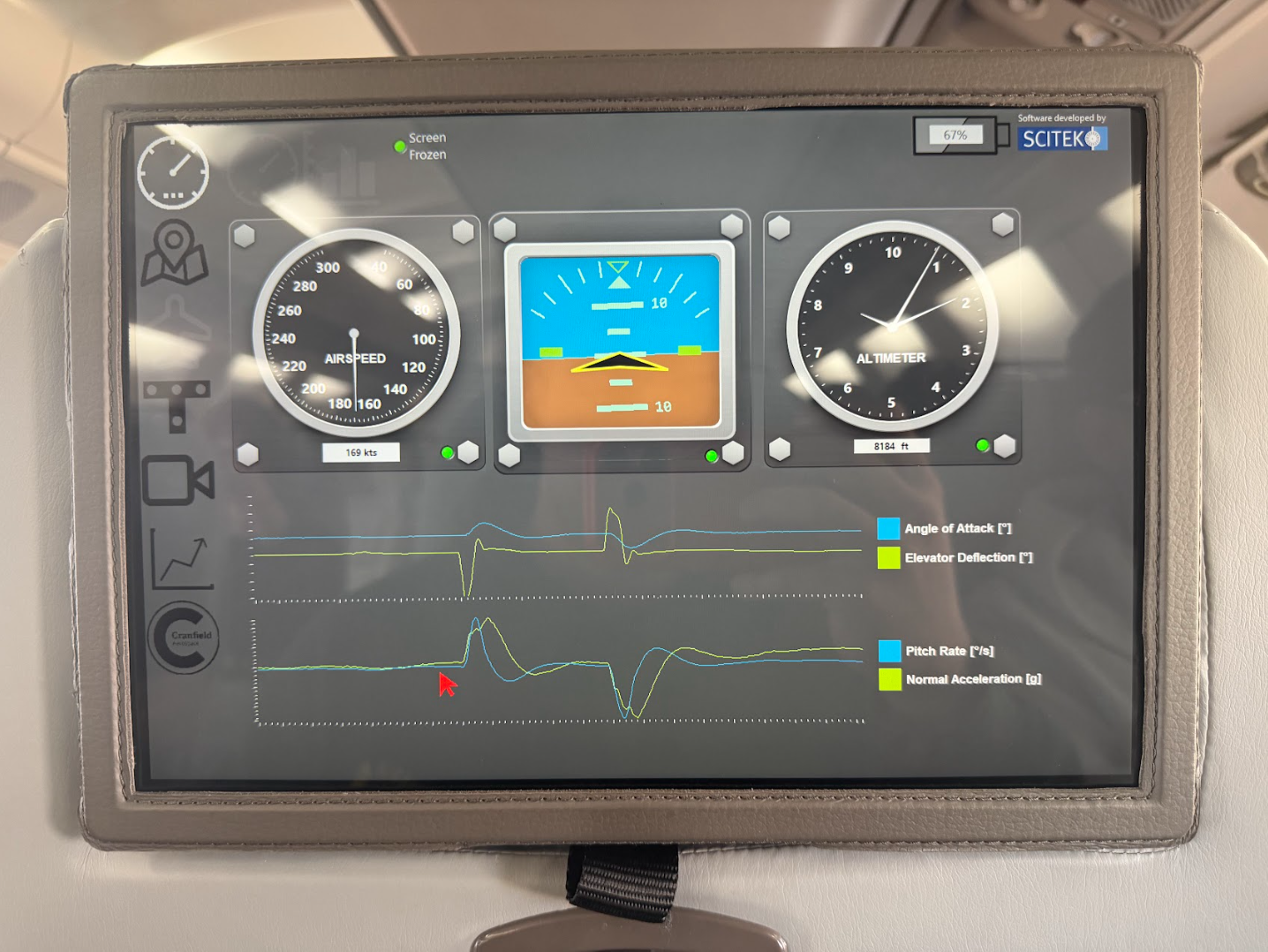
The investigation was conducted aboard Cranfield University's Saab 340B+ Flying Laboratory, equipped with specialised flight test instrumentation.
As a Task Specialist, I participated in recording experimental measurements during prescribed flight conditions.
The principal variables investigated were:
Elevator deflection, η
Trim tab deflection, β
Elevator stick force, Pη
Normal acceleration, g
Aircraft weight coefficient, Cw
Centre-of-gravity position, expressed as a percentage of mean aerodynamic chord (% MAC)
These measurements formed the experimental basis for calculating the aircraft's longitudinal stability characteristics.
Longitudinal Static Stability Investigation
Static stability was investigated by examining the relationship between elevator deflection and aircraft weight coefficient.
The elevator deflection gradient, dη/dCw, was determined using linear regression.
The reported gradient was approximately −9.14, indicating positive longitudinal static stability under the sign convention adopted in the laboratory.
Stick-free stability was investigated using the relationship between trim tab deflection and weight coefficient.
The trim tab gradient, dβ/dCw, was calculated as approximately +5.14, indicating positive stick-free static stability.
These gradients were subsequently plotted against centre-of-gravity position and extrapolated to determine the respective neutral points.
Aircraft Weight and Balance Analysis
The aircraft's centre-of-gravity position was calculated using the mass and longitudinal moment contributions of the aircraft, fuel, occupants, and ballast.
The total aircraft mass was determined to be approximately 11,750 kg, with a total longitudinal moment of 128,696 kg·m.
Using the aircraft datum and mean aerodynamic chord reference, the centre-of-gravity position was calculated as:
CG = 23.1% MAC
This position provided the reference for evaluating the aircraft's longitudinal stability relative to its estimated neutral and manoeuvre points.
Longitudinal Manoeuvre Stability Investigation
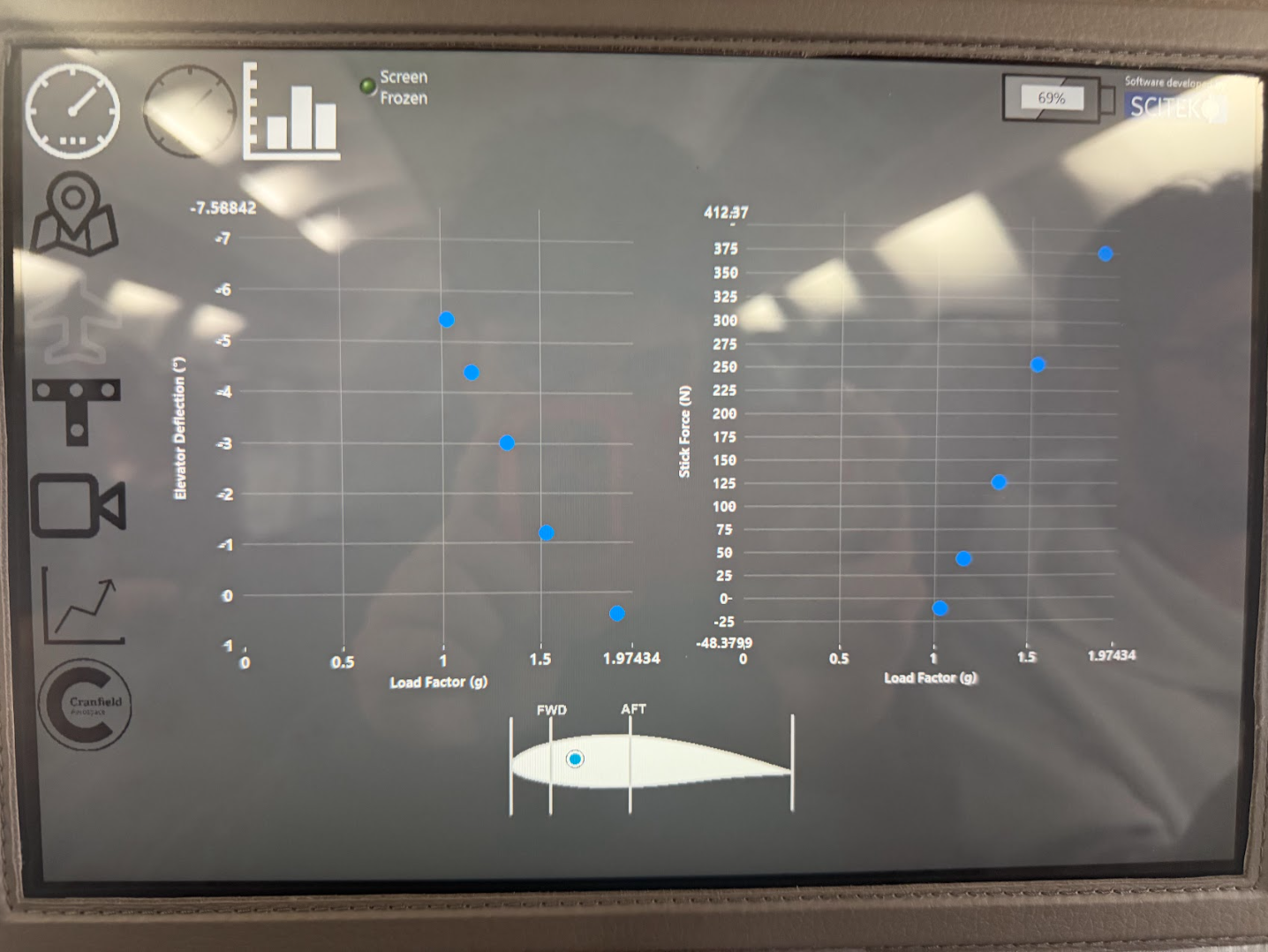
Manoeuvre stability was investigated by examining the aircraft's elevator deflection and stick force requirements at varying normal accelerations.
The elevator deflection gradient, dη/dg, was calculated as approximately −7.26 degrees per g, indicating that increasing normal acceleration required progressively greater elevator input.
The stick force gradient, dPη/dg, was calculated as approximately 403 N/g.
This positive relationship demonstrated that increasing normal acceleration required greater pilot control force.
The manoeuvre stability gradients were subsequently evaluated against centre-of-gravity position to estimate the stick-fixed and stick-free manoeuvre points.
Engineering Constraints and Challenges
Limited Centre-of-Gravity Test Conditions
The experimental data represented a limited range of centre-of-gravity positions. Consequently, the neutral and manoeuvre points were estimated through linear extrapolation rather than direct flight testing at the stability boundaries.
Experimental Measurement Uncertainty
The analysis relied on flight test measurements obtained from the aircraft's instrumentation. Sensor accuracy, measurement resolution, and variation in flight conditions could influence the calculated stability derivatives.
Aircraft Weight Distribution
Aircraft mass and centre-of-gravity position were influenced by the distribution of occupants, fuel, and ballast. Accurate weight and balance calculations were therefore essential for establishing the aircraft's test configuration.
Steady Flight Requirements
The static stability investigation depended on measurements obtained under approximately steady flight conditions. Variations in airspeed, acceleration, or aircraft attitude could introduce uncertainty into the resulting stability gradients.
Linear Extrapolation
Neutral and manoeuvre point estimates were obtained by extrapolating experimentally determined stability gradients. This introduced uncertainty because the calculated stability boundaries extended beyond the directly tested centre-of-gravity range.
Results and Stability Analysis
Aircraft Centre of Gravity
The aircraft's centre-of-gravity position was calculated as 23.1% MAC using the recorded loading configuration.
This placed the aircraft forward of the estimated static neutral points and manoeuvre points, indicating positive longitudinal stability under the investigated conditions.
Stick-Fixed Static Stability
The relationship between elevator deflection and weight coefficient produced a negative stability gradient of approximately −9.14.
This indicated positive stick-fixed longitudinal static stability, with elevator deflection changing to balance the aircraft's restoring pitching moment as aerodynamic loading increased.
The stability derivative was subsequently plotted against centre-of-gravity position.
Linear extrapolation produced an estimated:
Stick-fixed neutral point = 54.1% MAC
The results indicated that moving the CG aft reduced the aircraft's longitudinal static stability.
Stick-Free Static Stability
The relationship between trim tab deflection and weight coefficient produced a positive gradient of approximately +5.14.
This indicated positive stick-free longitudinal static stability under the experimental sign convention.
Extrapolation of the trim tab stability derivative against CG position produced an estimated:
Stick-free neutral point = 74.6% MAC
The difference between the stick-fixed and stick-free neutral point estimates reflected the influence of elevator and trim tab hinge-moment behaviour on the aircraft's longitudinal stability characteristics.
Stick-Fixed Manoeuvre Stability
Elevator deflection became increasingly negative as normal acceleration increased.
The calculated elevator deflection gradient was approximately −7.26 degrees per g, indicating that increasing load factor required progressively greater elevator control input.
The gradient was subsequently evaluated against centre-of-gravity position.
Linear extrapolation produced an estimated:
Stick-fixed manoeuvre point = 63.1% MAC
The results demonstrated that moving the CG aft reduced the aircraft's stick-fixed manoeuvre stability.
Stick-Free Manoeuvre Stability
The relationship between elevator stick force and normal acceleration demonstrated that increasing load factor required greater control force.
The measured stick force gradient was approximately 403 N/g.
Further analysis of stick force per g against centre-of-gravity position produced an estimated:
Stick-free manoeuvre point = 71.5% MAC
The investigation also established the following stick force characteristics:
475 N/g at 16% CG
295 N/g at 37% CG
These results demonstrated that moving the CG aft reduced the control force required to generate a given increase in normal acceleration.
This relationship highlighted the influence of centre-of-gravity position on aircraft manoeuvrability and handling characteristics.
Engineering Conclusions and Recommendations
The experimental investigation demonstrated the relationship between aircraft centre-of-gravity position, longitudinal static stability, manoeuvre stability, and pilot control force requirements.
The calculated aircraft CG of 23.1% MAC was forward of the estimated neutral and manoeuvre points, indicating positive longitudinal stability under the investigated conditions.
The static stability analysis produced estimated stick-fixed and stick-free neutral points of 54.1% MAC and 74.6% MAC, respectively.
The manoeuvre stability analysis produced estimated stick-fixed and stick-free manoeuvre points of 63.1% MAC and 71.5% MAC, respectively.
The investigation also demonstrated that moving the centre of gravity aft reduced the elevator stick force required to generate a given normal acceleration.
These findings highlighted the importance of centre-of-gravity management in maintaining appropriate aircraft stability and handling characteristics.
Further investigation could include:
Additional flight testing across permitted centre-of-gravity configurations to improve stability derivative estimates.
Quantification of uncertainty associated with experimental measurements and extrapolated stability boundaries.
Comparison of experimental stability characteristics with theoretical aircraft flight dynamics models.
Investigation of longitudinal dynamic stability, including short-period and phugoid responses.
Further evaluation of pilot control-force requirements across different aircraft loading configurations.
Skills and Technical Experience
Experimental Flight Testing: Aircraft instrumentation, in-flight data acquisition, flight test observation, and prescribed experimental procedures.
Aircraft Stability and Control: Longitudinal static stability, manoeuvre stability, stick-fixed and stick-free characteristics, neutral points, and control-force gradients.
Flight Dynamics Analysis: Aircraft weight and balance, centre-of-gravity calculations, stability derivatives, and linear extrapolation.
Engineering Data Analysis: Experimental data processing, graphical interpretation, linear regression, and evaluation of aircraft stability characteristics.
Technical Communication: Preparation of an individual technical laboratory report, interpretation of experimental results, and presentation of engineering conclusions.
Professional Engineering Experience: Participation in a supervised experimental flight aboard an operational aircraft, applying theoretical flight dynamics principles to real aircraft measurements.